
テキストテキストテキストテキスト
テキストテキストテキストテキスト
In 1933, Rolex expressed its technical mastery through a fabrication method it named “Rolesor.” By mechanically removing the heat-oxidized layer at the joint surfaces and applying a whitening finish (“white firing”), the metals are brought to a clean, unified state. The frequent use of 14K and 9K solid gold bimetal reflects the difficulty of bonding 18K gold, whose lower melting point demands exquisite timing—such as preheating the stainless steel, with its lower thermal conductivity, to achieve perfect fusion. It is, in every sense, a near-miraculous craft.
To demonstrate the sophistication of Rolesor to the world, Rolex employed this technique across various models from 1933 onward. Among the most iconic was the Prince model known as the “Tiger,” distinguished by its striking striped construction of gold and stainless steel—an aesthetic that captivated collectors worldwide at the time.
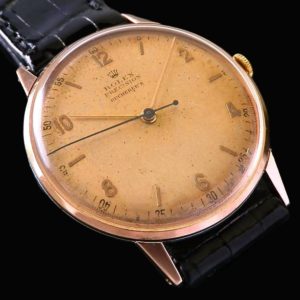
This particular Ref. 4363 is a masterful expression of Rolesor. By increasing the copper content, it achieves a deep, rich hue reminiscent of red gold, while offering improved thermal conductivity compared to stainless steel alone—facilitating a more seamless fusion during heat treatment. This is why Rolesor combinations with pink gold are so prevalent, and in this Ref. 4363, that warm crimson tone merges beautifully with steel to reveal a refined, noble character. The use of rose gold on the lugs and bezel further elevates its elegance, while the 35mm case asserts a balanced yet commanding presence.
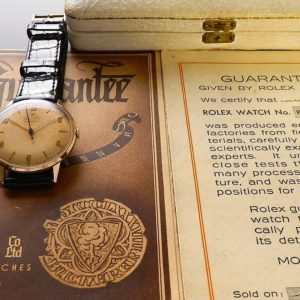
Moreover, this exceptional piece carries historical significance: in the 1930s, Bucherer played a pivotal role in distributing Rolex Oyster watches worldwide—so much so that it is said Rolex cannot be spoken of without Bucherer. In tribute, the retailer’s name was proudly printed on the dial, standing alongside Rolex itself. Accompanied by its original guarantee papers, full documentation, and genuine box from its time of sale at Bucherer, this is nothing short of a miraculous survivor.