
1936年5月1日からアメリカ、スイス通商協定の追加層として3文字のインポートコードの刻印を機械に刻むことを必須としたことからもEWCの役割が非常に強かったことが伺える。因みにEXUはカルティエのアメリカにおけるインポートコードである。因みにここでも真偽を問うポイントであるが、ケース、機械にEWCの刻印がある場合に、それが1936年以降の個体であれば、必ずインポートコードEXUを刻まなければならない。EWCを誕生させたきっかけとなる出来事は、その後のカルティエのリファレンスナンバーとシリアルナンバーの打ち方まで変えていく。
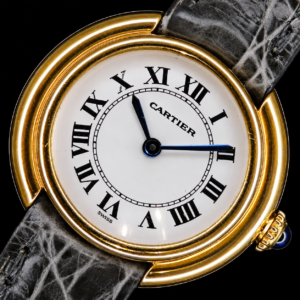
1960年にその時計におけるインポートに関してな刻印の規定が温和になるが、その間のお話しは次回の機会にするが、今回の一品のように、1960年代以降のパリ市場向けに裏蓋のParis表記にする事で、簡易的にフランス市場向けと表記させた。これは輸入代理店としてパリ、アメリカ、ロンドンにまで、関わりを持ったEWCの存在の真実も絡む事で実はパリに本社を置くカルティエだけで、他メーカーはの場合には未だ刻印の縛りは全て解放するまで時間がかかる。60年代のカルティエはリファレンスナンバーを未だ明確にはしておらず、1970年代に入りルイカルティエコレクションにより、裏蓋にリファレンスナンバーとシリアルを続きで刻み、1980年前後までは4桁のシリアル、90年前後までを5桁のシリアルで管理した。今回の一品ヴァンドーム。フランスのパリのグランサンクの歴史から始まり、高級ジュエラーの聖地の名とし現在もカルティエ本店やカルティエのサービスセンターもヴァンドームの近くにあり、グランサンクとは違う存在としてカルティエ自身、ヴァンドームとしとの威厳をカルティエのストーリーとしたのかもしれない。今回の一品は刻印の証たるリファレンスは、67080. シリアルは3348の4桁で、PARIS刻で、1970年前後から1980年前後まで、文字盤はエナメル仕上げのフラットAのマーク2、18金無垢のスイスホールにフランス18金無垢のフクロウ刻印があり、機械はインハウスナンバー67としたETA2412キャリバーが搭載される。ルイカルティエコレクションのレディースモデルとして、1973年から発表されたヴァンドームと初期の一品、現在、世界的市場から消えてしまったたが、真実を繋ぐ一品がここに存在する。
The fact that, from May 1, 1936, a three-letter import code had to be stamped on the movement as an additional requirement under the U.S.–Swiss trade agreement shows just how significant EWC’s role was. EXU, incidentally, was Cartier’s U.S. import code. This is also an important point to verify: if a watch dating from 1936 or later has EWC markings on its case and movement, it must also bear the EXU import code. The event that led to the creation of EWC would go on to change the way Cartier stamped its reference and serial numbers.
In 1960, the regulations governing import-related markings on watches were relaxed. I will discuss that period another time. For watches like this example, from the 1960s onward, “PARIS” was stamped on the caseback as a simple indication that the watch was intended for the French market. This also relates to the true nature of EWC, which was involved as an import agent in Paris, the United States, and even London. In fact, this applied specifically to Cartier, whose headquarters were in Paris. Other manufacturers took longer to have all their marking restrictions lifted.
In the 1960s, Cartier had not yet established a clear reference-numbering system. Then, in the 1970s, with the Louis Cartier Collection, the reference and serial numbers were stamped consecutively on the caseback. Serial numbers had four digits until around 1980, and five digits until around 1990.
This example is a Vendôme. Its story may begin with the history of the Grand Cinq in Paris, and with the name of a place regarded as a sanctuary for high-end jewelers. Cartier’s flagship store and service center are still near Vendôme today. Perhaps Cartier made the prestige of Vendôme—distinct from that of the Grand Cinq—part of its own story.
This example bears reference number 67080 and the four-digit serial number 3348, along with a “PARIS” marking. It dates from around 1970 to around 1980. The dial has a Mark II enamel finish with a flat “A.” The watch has a Swiss 18-karat solid-gold hallmark and a French 18-karat solid-gold owl hallmark on the case. It is powered by an ETA 2412 caliber designated with the in-house number 67.
Introduced in 1973 as a ladies’ model in the Louis Cartier Collection, the Vendôme is now rarely seen on the global market. Yet this early example remains—a piece that preserves and connects us to the truth of its history.